Nucleation
Overview
Nucleation is the process by which gas-phase molecules spontaneously form small clusters (nuclei) that can grow into aerosol particles. This module implements classical nucleation theory for single-component (homogeneous) nucleation following the treatment in Seinfeld & Pandis (2006), Chapter 11.
The key outputs of the nucleation model are:
- Critical cluster size (i*): The minimum number of molecules required for a stable cluster
- Critical radius (r*): The radius of the critical cluster
- Nucleation rate (J): The rate at which new particles form per unit volume per unit time
- Free energy barrier (ΔG*): The energy barrier that must be overcome for nucleation to occur
Reference: Seinfeld, J.H. and Pandis, S.N. (2006). Atmospheric Chemistry and Physics: From Air Pollution to Climate Change, 2nd Edition, Chapter 11, pp. 489-536.
Aerosol.Nucleation — Function
Nucleation(; name=:Nucleation)A component representing homogeneous nucleation of a single-component vapor following classical nucleation theory from Seinfeld & Pandis (2006), Chapter 11.
This component calculates the nucleation rate, critical cluster size, and critical radius based on the saturation ratio, temperature, and species properties.
Variables
S: Saturation ratio (dimensionless), ratio of partial pressure to saturation vapor pressureJ: Nucleation rate (molecules/(m³·s))i_star: Critical cluster size (molecules)r_star: Critical cluster radius (m)ΔG_star: Free energy barrier (J)θ: Dimensionless surface tension parameter
Parameters
T: Temperature (K)p_A: Partial pressure of condensing species (Pa)p_A_s: Saturation vapor pressure (Pa)σ: Surface tension (N/m)v_1: Molecular volume (m³/molecule)m_1: Molecular mass (kg/molecule)
References
Seinfeld, J.H. and Pandis, S.N. (2006). Atmospheric Chemistry and Physics: From Air Pollution to Climate Change, 2nd Edition, Chapter 11, pp. 489-536.
Aerosol.CriticalCluster — Function
CriticalCluster(; name=:CriticalCluster)A standalone component for computing critical cluster properties without the full nucleation rate calculation. Useful for parameter sensitivity studies.
This implements equations 11.35, 11.52, and 11.53 from Seinfeld & Pandis (2006).
Variables
i_star: Critical cluster size (molecules)r_star: Critical cluster radius (m)ΔG_star: Free energy barrier (J)θ: Dimensionless surface tension parameter
Parameters
T: Temperature (K)S: Saturation ratioσ: Surface tension (N/m)v_1: Molecular volume (m³/molecule)
Aerosol.ClassicalNucleationRate — Function
ClassicalNucleationRate(; name=:ClassicalNucleationRate)A simplified component that computes only the classical nucleation rate (Eq. 11.47) from Seinfeld & Pandis (2006). This is a minimal component for use when critical cluster properties are not needed.
Variables
J: Nucleation rate (molecules/(m³·s))
Parameters
T: Temperature (K)S: Saturation ratioN_1: Monomer number concentration (molecules/m³)σ: Surface tension (N/m)v_1: Molecular volume (m³/molecule)m_1: Molecular mass (kg/molecule)
Aerosol.WaterProperties — Function
WaterProperties(; name=:WaterProperties)A component providing temperature-dependent physical properties of water for nucleation calculations following the data from Seinfeld & Pandis (2006), Table 11.1 and 11.4.
Variables
σ: Surface tension (N/m)v_1: Molecular volume (m³/molecule)m_1: Molecular mass (kg/molecule)p_sat: Saturation vapor pressure (Pa)
Parameters
T: Temperature (K)
References
Seinfeld, J.H. and Pandis, S.N. (2006). Atmospheric Chemistry and Physics, Chapter 11.
Implementation
The implementation follows classical nucleation theory, which treats the formation of molecular clusters using thermodynamic arguments. The key assumption is the capillarity approximation: clusters of all sizes are assumed to have the same surface tension as bulk liquid.
State Variables
using DataFrames, ModelingToolkit, Symbolics, DynamicQuantities
using Aerosol
using OrdinaryDiffEq
using Plots

sys = Nucleation()
vars = unknowns(sys)
DataFrame(
    :Name => [string(Symbolics.tosymbol(v, escape = false)) for v in vars],
    :Units => [ModelingToolkit.get_unit(v) for v in vars],
    :Description => [ModelingToolkit.getdescription(v) for v in vars]
)| Row | Name | Units | Description |
|---|---|---|---|
| String | Quantity… | String | |
| 1 | S | 1.0 | Saturation ratio (dimensionless) |
| 2 | N_1 | 1.0 m⁻³ | Monomer number concentration |
| 3 | a_1 | 1.0 m² | Monomer surface area |
| 4 | θ | 1.0 | Dimensionless surface tension (dimensionless) |
| 5 | i_star | 1.0 | Critical cluster size (dimensionless) |
| 6 | r_star | 1.0 m | Critical cluster radius |
| 7 | ΔG_star | 1.0 m² kg s⁻² | Free energy barrier |
| 8 | J | 1.0 m⁻³ s⁻¹ | Nucleation rate |
Parameters
pars = parameters(sys)
DataFrame(
    :Name => [string(Symbolics.tosymbol(p, escape = false)) for p in pars],
    :Units => [ModelingToolkit.get_unit(p) for p in pars],
    :Description => [ModelingToolkit.getdescription(p) for p in pars]
)| Row | Name | Units | Description |
|---|---|---|---|
| String | Quantity… | String | |
| 1 | p_A | 1.0 m⁻¹ kg s⁻² | Partial pressure of condensing species |
| 2 | p_A_s | 1.0 m⁻¹ kg s⁻² | Saturation vapor pressure |
| 3 | T | 1.0 K | Temperature |
| 4 | k_B | 1.0 m² kg s⁻² K⁻¹ | Boltzmann constant |
| 5 | π_val | 1.0 | Pi (dimensionless) |
| 6 | v_1 | 1.0 m³ | Molecular volume |
| 7 | σ | 1.0 kg s⁻² | Surface tension |
| 8 | m_1 | 1.0 kg | Molecular mass |
Equations
The system implements the following equations from Seinfeld & Pandis (2006):
eqs = equations(sys)8-element Vector{Symbolics.Equation}:
S(t) ~ p_A / p_A_s
N_1(t) ~ p_A / (T*k_B)
a_1(t) ~ 4(((3v_1) / (4π_val))^(2//3))*π_val
θ(t) ~ (3.3019272488946263(v_1^(2//3))*(π_val^(1//3))*σ) / (T*k_B)
i_star(t) ~ ((2θ(t)) / (3log(S(t))))^3
r_star(t) ~ (2v_1*σ) / (T*k_B*log(S(t)))
ΔG_star(t) ~ (16(v_1^2)*π_val*(σ^3)) / (3(T^2)*(k_B^2)*(log(S(t))^2))
J(t) ~ ((N_1(t)^2)*exp((-16(v_1^2)*π_val*(σ^3)) / (3(T^3)*(k_B^3)*(log(S(t))^2)))*sqrt((2σ) / (m_1*π_val))*v_1) / S(t)Core Equations
The saturation ratio (Eq. 11.1) is the ratio of partial pressure to saturation vapor pressure:
\[S = \frac{p_A}{p_A^s(T)}\]
The critical cluster size (Eq. 11.35) is determined by the competition between bulk and surface terms:
\[i^* = \left(\frac{2\theta}{3\ln S}\right)^3\]
where θ is the dimensionless surface tension parameter (Eq. 11.27):
\[\theta = \frac{(36\pi)^{1/3} v_1^{2/3} \sigma}{k_B T}\]
The critical radius (Eq. 11.52) follows from the Kelvin equation:
\[r^* = \frac{2\sigma v_1}{k_B T \ln S}\]
The free energy barrier (Eq. 11.53) is:
\[\Delta G^* = \frac{16\pi}{3} \frac{v_1^2 \sigma^3}{(k_B T \ln S)^2}\]
The classical nucleation rate (Eq. 11.47) gives the rate of new particle formation:
\[J = \sqrt{\frac{2\sigma}{\pi m_1}} \frac{v_1 N_1^2}{S} \exp\left(-\frac{16\pi}{3} \frac{v_1^2 \sigma^3}{(k_B T)^3 (\ln S)^2}\right)\]
Analysis
Validation Against Table 11.1: Critical Cluster Properties for Water
The following analysis reproduces Table 11.1 from Seinfeld & Pandis (2006), showing critical cluster properties for water at 273 K and 298 K.
using OrdinaryDiffEq

# Water properties from Table 11.1
σ_273 = 75.6e-3  # N/m at 273 K
σ_298 = 72.0e-3  # N/m at 298 K
v_1 = 2.99e-29   # m³/molecule

sys = CriticalCluster()
compiled = mtkcompile(sys)

# Calculate for 273 K
results_273 = []
for S in [2, 3, 4, 5]
    prob = ODEProblem(compiled,
        Dict(
            compiled.T => 273.0,
            compiled.S => Float64(S),
            compiled.σ => σ_273,
            compiled.v_1 => v_1
        ),
        (0.0, 1.0))
    sol = solve(prob, Tsit5())
    r_star_angstrom = sol[compiled.r_star][1] * 1e10  # Convert to Å
    i_star = sol[compiled.i_star][1]
    push!(results_273, (
        S = S, r_star = round(r_star_angstrom, digits = 1), i_star = round(Int, i_star)))
end

# Calculate for 298 K
results_298 = []
for S in [2, 3, 4, 5]
    prob = ODEProblem(compiled,
        Dict(
            compiled.T => 298.0,
            compiled.S => Float64(S),
            compiled.σ => σ_298,
            compiled.v_1 => v_1
        ),
        (0.0, 1.0))
    sol = solve(prob, Tsit5())
    r_star_angstrom = sol[compiled.r_star][1] * 1e10
    i_star = sol[compiled.i_star][1]
    push!(results_298, (
        S = S, r_star = round(r_star_angstrom, digits = 1), i_star = round(Int, i_star)))
end

# Display results as a table
println("Table 11.1: Critical Number and Radius for Water Droplets")
println("="^70)
println("        T = 273 K                    T = 298 K")
println("S    r* (Å)    i*                r* (Å)    i*")
println("-"^70)
for (r273, r298) in zip(results_273, results_298)
    println("$(r273.S)    $(r273.r_star)       $(r273.i_star)                 $(r298.r_star)       $(r298.i_star)")
end

# Expected values from Table 11.1
println("\nExpected values from Seinfeld & Pandis Table 11.1:")
println("T=273K: S=2: r*=17.3Å, i*=726; S=3: r*=10.9Å, i*=182; S=4: r*=8.7Å, i*=87; S=5: r*=7.5Å, i*=58")
println("T=298K: S=2: r*=15.1Å, i*=482; S=3: r*=9.5Å, i*=121; S=4: r*=7.6Å, i*=60; S=5: r*=6.5Å, i*=39")
Table 11.1: Critical Number and Radius for Water Droplets
======================================================================
T = 273 K T = 298 K
S r* (Å) i* r* (Å) i*
----------------------------------------------------------------------
2 17.3 726 15.1 482
3 10.9 182 9.5 121
4 8.7 91 7.5 60
5 7.5 58 6.5 39
Expected values from Seinfeld & Pandis Table 11.1:
T=273K: S=2: r*=17.3Å, i*=726; S=3: r*=10.9Å, i*=182; S=4: r*=8.7Å, i*=87; S=5: r*=7.5Å, i*=58
T=298K: S=2: r*=15.1Å, i*=482; S=3: r*=9.5Å, i*=121; S=4: r*=7.6Å, i*=60; S=5: r*=6.5Å, i*=39Validation Against Table 11.4: Nucleation Rates for Water
This reproduces Table 11.4 from Seinfeld & Pandis (2006), showing nucleation rates for water at 293 K.
# Water properties at 293 K from Table 11.4
σ_293 = 72.75e-3      # N/m
v_1 = 2.99e-29        # m³/molecule
m_1 = 2.99e-26        # kg/molecule
p_sat_293 = 2336.5    # Pa

sys = Nucleation()
compiled = mtkcompile(sys)

println("Table 11.4: Homogeneous Nucleation Rate and Critical Cluster Size for Water at T = 293 K")
println("="^80)
println("S      i*      J (cm⁻³s⁻¹)           Expected J")
println("-"^80)

expected_J = Dict(2 => 5.02e-54, 3 => 1.76e-6, 4 => 1.05e6, 5 => 1.57e11,
    6 => 1.24e14, 7 => 8.99e15, 8 => 1.79e17, 9 => 1.65e18, 10 => 9.17e18)

for S in [2, 3, 4, 5, 6, 7, 8, 9, 10]
    prob = ODEProblem(compiled,
        Dict(
            compiled.T => 293.0,
            compiled.p_A => Float64(S) * p_sat_293,
            compiled.p_A_s => p_sat_293,
            compiled.σ => σ_293,
            compiled.v_1 => v_1,
            compiled.m_1 => m_1
        ),
        (0.0, 1.0))
    sol = solve(prob, Tsit5())
    J = sol[compiled.J][1] * 1e-6  # Convert from m⁻³s⁻¹ to cm⁻³s⁻¹
    i_star = sol[compiled.i_star][1]
    println("$(S)      $(round(Int, i_star))      $(round(J, sigdigits=3))           $(expected_J[S])")
end
Table 11.4: Homogeneous Nucleation Rate and Critical Cluster Size for Water at T = 293 K
================================================================================
S i* J (cm⁻³s⁻¹) Expected J
--------------------------------------------------------------------------------
2 523 4.38e-54 5.02e-54
3 131 1.66e-6 1.76e-6
4 65 1.02e6 1.05e6
5 42 1.53e11 1.57e11
6 30 1.22e14 1.24e14
7 24 8.84e15 8.99e15
8 19 1.76e17 1.79e17
9 16 1.62e18 1.65e18
10 14 9.06e18 9.17e18Figure: Critical Cluster Size vs. Saturation Ratio
This figure shows how the critical cluster size decreases with increasing saturation ratio, demonstrating why nucleation "switches on" sharply at a threshold supersaturation.
using Plots

S_range = 1.5:0.1:10.0
i_stars = Float64[]
r_stars = Float64[]

sys = CriticalCluster()
compiled = mtkcompile(sys)

for S in S_range
    prob = ODEProblem(compiled,
        Dict(
            compiled.T => 293.0,
            compiled.S => S,
            compiled.σ => 72.75e-3,
            compiled.v_1 => 2.99e-29
        ),
        (0.0, 1.0))
    sol = solve(prob, Tsit5())
    push!(i_stars, sol[compiled.i_star][1])
    push!(r_stars, sol[compiled.r_star][1] * 1e10)  # Convert to Å
end

p1 = plot(
    S_range, i_stars, xlabel = "Saturation Ratio S", ylabel = "Critical Cluster Size i*",
    label = "i*", lw = 2, legend = :topright, yscale = :log10,
    title = "Critical Cluster Size vs. Saturation Ratio (T=293K)")

p2 = plot(
    S_range, r_stars, xlabel = "Saturation Ratio S", ylabel = "Critical Radius r* (Å)",
    label = "r*", lw = 2, legend = :topright,
    title = "Critical Radius vs. Saturation Ratio (T=293K)")

plot(p1, p2, layout = (1, 2), size = (900, 400))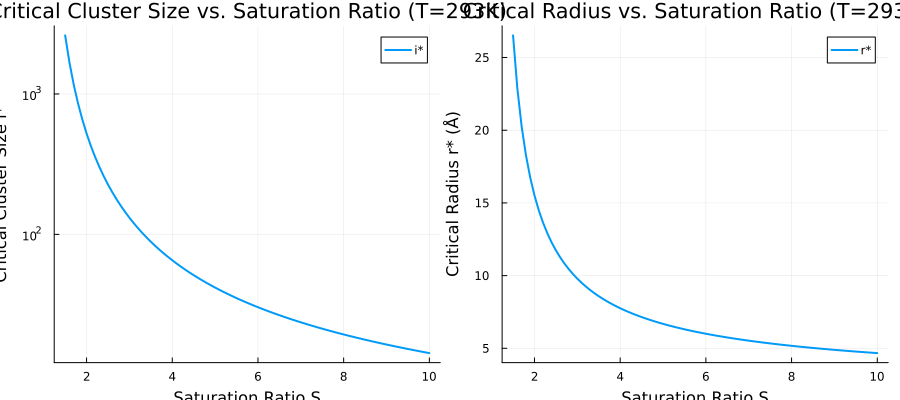
Figure: Nucleation Rate vs. Saturation Ratio (analogous to Table 11.4)
This figure illustrates the extreme sensitivity of nucleation rate to saturation ratio.
S_range = 2.0:0.5:10.0
J_rates = Float64[]

sys = Nucleation()
compiled = mtkcompile(sys)

for S in S_range
    prob = ODEProblem(compiled,
        Dict(
            compiled.T => 293.0,
            compiled.p_A => S * 2336.5,
            compiled.p_A_s => 2336.5,
            compiled.σ => 72.75e-3,
            compiled.v_1 => 2.99e-29,
            compiled.m_1 => 2.99e-26
        ),
        (0.0, 1.0))
    sol = solve(prob, Tsit5())
    J = sol[compiled.J][1] * 1e-6  # Convert to cm⁻³s⁻¹
    push!(J_rates, max(J, 1e-60))  # Floor at 1e-60 for log scale
end

plot(
    S_range, J_rates, xlabel = "Saturation Ratio S", ylabel = "Nucleation Rate J (cm⁻³s⁻¹)",
    label = "J", lw = 2, yscale = :log10,
    title = "Classical Nucleation Rate vs. Saturation Ratio (Water at 293K)",
    ylims = (1e-60, 1e25), legend = :bottomright)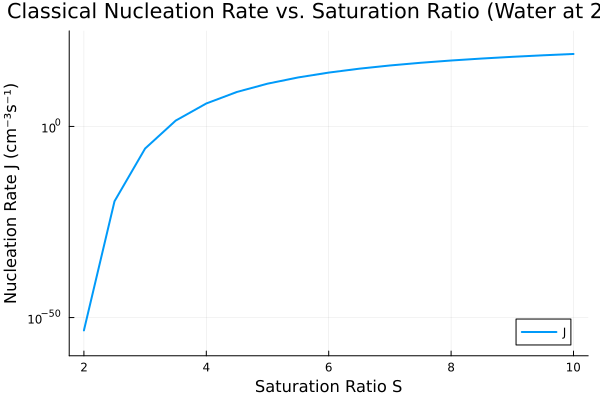
Temperature Dependence of Critical Properties
This analysis shows how temperature affects critical cluster properties at a fixed saturation ratio.
T_range = 250.0:5.0:320.0
S = 4.0

i_stars_T = Float64[]
r_stars_T = Float64[]

# Approximate temperature-dependent surface tension: σ ≈ 75.6 - 0.1454*(T-273) mN/m
σ_func(T) = (75.6 - 0.1454 * (T - 273)) * 1e-3

sys = CriticalCluster()
compiled = mtkcompile(sys)

for T in T_range
    prob = ODEProblem(compiled,
        Dict(
            compiled.T => T,
            compiled.S => S,
            compiled.σ => σ_func(T),
            compiled.v_1 => 2.99e-29
        ),
        (0.0, 1.0))
    sol = solve(prob, Tsit5())
    push!(i_stars_T, sol[compiled.i_star][1])
    push!(r_stars_T, sol[compiled.r_star][1] * 1e10)
end

p1 = plot(
    T_range, i_stars_T, xlabel = "Temperature (K)", ylabel = "Critical Cluster Size i*",
    label = "i*", lw = 2, title = "Critical Cluster Size vs. Temperature (S=4)")

p2 = plot(
    T_range, r_stars_T, xlabel = "Temperature (K)", ylabel = "Critical Radius r* (Å)",
    label = "r*", lw = 2, title = "Critical Radius vs. Temperature (S=4)")

plot(p1, p2, layout = (1, 2), size = (900, 400))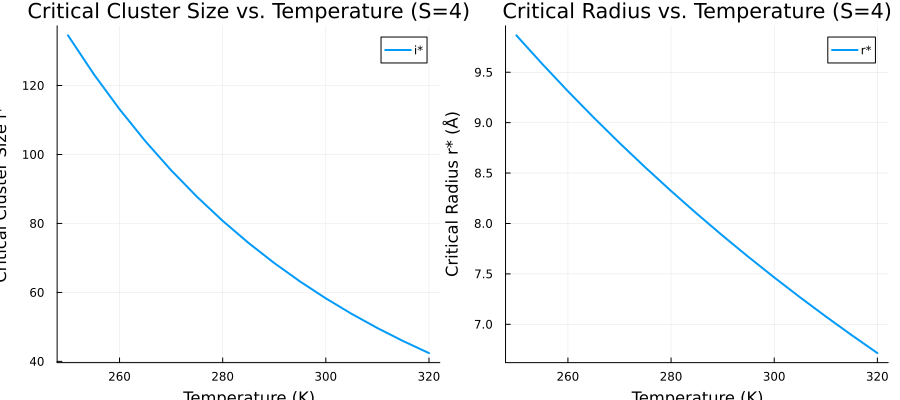
Key Behaviors
Saturation Ratio Dependence
The nucleation rate is extremely sensitive to the saturation ratio S:
- At S < 2, nucleation is essentially zero for atmospheric conditions
- The transition from negligible to significant nucleation occurs over a narrow range of S
- At high S (> 5), the rate increases by many orders of magnitude per unit increase in S
Temperature Dependence
Temperature affects nucleation through multiple pathways:
- Higher T reduces the free energy barrier, increasing J
- Higher T increases vapor pressure, affecting S
- Surface tension typically decreases with T
Critical Cluster Size
The critical cluster size i* decreases with increasing S:
- At low S, very large clusters are needed before they become stable
- At high S, even small clusters can grow spontaneously
- This explains why nucleation "switches on" sharply at a threshold S
Limitations
Capillarity approximation: The model assumes clusters of all sizes have bulk liquid surface tension, which becomes inaccurate for small clusters (i* < 20-30).
Single-component only: This implementation covers homogeneous single-component nucleation. Binary nucleation (e.g., H₂SO₄-H₂O) requires additional equations not yet implemented.
Steady-state assumption: The classical nucleation rate assumes the cluster distribution has reached steady state.
No kinetic effects: The model does not account for non-equilibrium effects or condensation/evaporation kinetics beyond the equilibrium rate constants.