Aqueous Chemistry
Overview
Atmospheric aqueous-phase chemistry module implementing equations from Seinfeld & Pandis Chapter 7: "Atmospheric Aqueous-Phase Chemistry".
Aqueous-phase chemistry occurs in cloud droplets, fog droplets, and deliquesced aerosol particles. These processes are critical for:
- Formation of secondary aerosol components (especially sulfate)
- pH regulation in atmospheric water
- Redistribution of species between gas and aqueous phases
- Oxidation of dissolved gases
This module provides ModelingToolkit.jl systems for:
- Henry's law gas-liquid equilibrium
- Aqueous dissociation equilibria (CO2, SO2, NH3, HNO3, H2O2, O3)
- S(IV) to S(VI) oxidation kinetics
- Combined cloud droplet chemistry
Reference: Seinfeld, J.H. and Pandis, S.N., "Atmospheric Chemistry and Physics: From Air Pollution to Climate Change", 3rd Edition, Wiley, 2016, Chapter 7.
Aerosol.CloudChemistry — Function
CloudChemistry(; name=:CloudChem)Comprehensive cloud droplet chemistry system combining all equilibria and S(IV) oxidation kinetics.
This is the main component for modeling atmospheric aqueous-phase chemistry. It combines:
- Water autoionization equilibrium
- CO2/bicarbonate/carbonate equilibria
- SO2/bisulfite/sulfite (S(IV)) equilibria
- NH3/ammonium equilibria
- HNO3/nitrate equilibria
- H2O2 equilibria
- O3 dissolution
- S(IV) oxidation kinetics (O3, H2O2, Fe, Mn pathways)
The pH is determined from the electroneutrality condition (Eq 7.114): [H+] + [NH4+] = [OH-] + [HCO3-] + 2[CO3^2-] + [HSO3-] + 2[SO3^2-] + [NO3-] + [Cl-] + 2[SO4^2-]
Parameters:
- L: Liquid water content (g/m³)
- xi_SO2: SO2 mixing ratio for lifetime calculations (dimensionless)
Input Variables (partial pressures and metal concentrations):
- T: Temperature (K)
- p_CO2: CO2 partial pressure (Pa)
- p_SO2: SO2 partial pressure (Pa)
- p_NH3: NH3 partial pressure (Pa)
- p_HNO3: HNO3 partial pressure (Pa)
- p_H2O2: H2O2 partial pressure (Pa)
- p_O3: O3 partial pressure (Pa)
- Fe_III: Fe(III) concentration in droplet (mol/m³)
- Mn_II: Mn(II) concentration in droplet (mol/m³)
- Cl_minus: Chloride concentration (mol/m³)
- SO4_2minus: Sulfate concentration (mol/m³)
Output Variables:
- pH: Droplet pH (dimensionless)
- H_plus: H+ concentration (mol/m³)
- All aqueous species concentrations
- S(IV) oxidation rates # Create subsystems for equilibria
- Sulfate production rate
Implementation
All pressures use SI units (Pa). Henry's law constants from the textbook (M/atm) are internally converted to M/Pa by dividing by 101325. Concentrations are in mol/L, temperatures in K.
Henry's Law Components
Henry's law describes the equilibrium partitioning of gases between the gas phase and aqueous phase.
Aerosol.HenrysLaw — Function
HenrysLaw(; name=:HenrysLaw)Basic Henry's law equilibrium at fixed temperature.
Implements Eq 7.3: [A(aq)] = HA * pA
Parameters:
- H_A: Henry's law constant (mol/m³/Pa)
Variables:
- p_A: Partial pressure of gas A (Pa)
- C_aq: Aqueous concentration (mol/m³)
This component establishes the equilibrium relationship between gas-phase partial pressure and aqueous-phase concentration.
Aerosol.HenrysLawTemperature — Function
HenrysLawTemperature(; name=:HenrysLawTemp)Temperature-dependent Henry's law equilibrium.
Implements:
- Eq 7.3: [A(aq)] = HA(T) * pA
- Eq 7.5: HA(T) = HA(Tref) * exp((ΔHA/R) * (1/T_ref - 1/T))
Parameters:
- H_298: Henry's law constant at 298 K (mol/m³/Pa)
- dH_diss: Heat of dissolution (J/mol)
Variables:
- T: Temperature (K)
- p_A: Partial pressure (Pa)
- C_aq: Aqueous concentration (mol/m³)
- H_T: Temperature-corrected Henry's law constant (mol/m³/Pa)
Also calculates:
- w_L: Liquid water mixing ratio (dimensionless, vol/vol)
- f_A: Distribution factor (dimensionless)
- X_aq: Aqueous fraction (dimensionless)
Aerosol.EffectiveHenrysLaw — Function
EffectiveHenrysLaw(; name=:EffectiveHenrys)Effective Henry's law constant accounting for aqueous dissociation.
For species that dissociate in water, the effective Henry's law constant H* is larger than the intrinsic Henry's law constant H because dissociation products contribute to the total dissolved amount.
Implements:
- Eq 7.24: HCO2 = HCO2 * (1 + Kc1/[H+] + Kc1K_c2/[H+]^2)
- Eq 7.41: HSO2 = HSO2 * (1 + Ks1/[H+] + Ks1K_s2/[H+]^2)
- Eq 7.61: H*HNO3 ~ HHNO3 * K_n1 / [H+]
Parameters:
- H_intrinsic: Intrinsic Henry's law constant (mol/m³/Pa)
- K_1: First dissociation constant (mol/m³)
- K_2: Second dissociation constant (mol/m³), set to 0 for monoprotic acids
Variables:
- H_plus: Hydrogen ion concentration (mol/m³)
- H_eff: Effective Henry's law constant (mol/m³/Pa)
Aqueous Equilibria
Aerosol.WaterEquilibrium — Function
WaterEquilibrium(; name=:WaterEq)Water autoionization equilibrium with temperature dependence.
Implements:
- Eq 7.10-7.12: H2O <-> H+ + OH-
- Eq 7.13: pH = -log10[H+]
- Table 7.4: Kw(T) = Kw(298) * exp((-dH/R) * (1/T - 1/298))
Variables:
- T: Temperature (K)
- H_plus: Hydrogen ion concentration (mol/m³)
- OH_minus: Hydroxide ion concentration (mol/m³)
- K_w: Water dissociation constant (mol²/m⁶)
- pH: Negative log of H+ concentration (dimensionless)
Aerosol.CO2Equilibria — Function
CO2Equilibria(; name=:CO2Eq)CO2 dissolution and dissociation equilibria with temperature dependence.
Implements:
- Eq 7.14-7.16: CO2(g) <-> CO2.H2O <-> H+ + HCO3- <-> H+ + CO3^2-
- Eq 7.17: HCO2 = [CO2.H2O] / pCO2
- Eq 7.18: K_c1 = [H+][HCO3-] / [CO2.H2O]
- Eq 7.19: K_c2 = [H+][CO3^2-] / [HCO3-]
- Eq 7.20-7.22: Species concentrations
- Eq 7.24: HCO2 = HCO2 * (1 + Kc1/[H+] + Kc1K_c2/[H+]^2)
Variables:
- T: Temperature (K)
- H_plus: Hydrogen ion concentration (mol/m³)
- p_CO2: Partial pressure of CO2 (Pa)
- CO2_aq: [CO2.H2O] concentration (mol/m³)
- HCO3_minus: Bicarbonate concentration (mol/m³)
- CO3_2minus: Carbonate concentration (mol/m³)
- C_total: Total dissolved inorganic carbon (mol/m³)
- HCO2eff: Effective Henry's law constant (mol/m³/Pa)
Aerosol.SO2Equilibria — Function
SO2Equilibria(; name=:SO2Eq)SO2 dissolution and dissociation equilibria with temperature dependence. This is the S(IV) system.
Implements:
- Eq 7.30-7.32: SO2(g) <-> SO2.H2O <-> H+ + HSO3- <-> H+ + SO3^2-
- Eq 7.33: HSO2 = [SO2.H2O] / pSO2
- Eq 7.34: K_s1 = [H+][HSO3-] / [SO2.H2O]
- Eq 7.35: K_s2 = [H+][SO3^2-] / [HSO3-]
- Eq 7.36-7.38: S(IV) species concentrations
- Eq 7.39: [S(IV)] = [SO2.H2O] + [HSO3-] + [SO3^2-]
- Eq 7.40: [S(IV)] = HSO2 * pSO2 * (1 + Ks1/[H+] + Ks1*K_s2/[H+]^2)
- Eq 7.41: HS(IV) = HSO2 * (1 + Ks1/[H+] + Ks1K_s2/[H+]^2)
- Eq 7.43-7.45: S(IV) mole fractions (alpha values)
Variables:
- T: Temperature (K)
- H_plus: Hydrogen ion concentration (mol/m³)
- p_SO2: Partial pressure of SO2 (Pa)
- SO2_aq: [SO2.H2O] concentration (mol/m³)
- HSO3_minus: Bisulfite concentration (mol/m³)
- SO3_2minus: Sulfite concentration (mol/m³)
- SIVtotal: Total S(IV) concentration (mol/m³)
- HSO2eff: Effective Henry's law constant (mol/m³/Pa)
- alpha_0: Mole fraction of SO2.H2O (dimensionless)
- alpha_1: Mole fraction of HSO3- (dimensionless)
- alpha_2: Mole fraction of SO3^2- (dimensionless)
Aerosol.NH3Equilibria — Function
NH3Equilibria(; name=:NH3Eq)NH3 dissolution and dissociation equilibria with temperature dependence.
Implements:
- Eq 7.46-7.47: NH3(g) <-> NH3.H2O <-> NH4+ + OH-
- Eq 7.48: HNH3 = [NH3.H2O] / pNH3
- Eq 7.49: K_a1 = [NH4+][OH-] / [NH3.H2O]
- Eq 7.50: [NH4+] = (HNH3 * Ka1 / Kw) * pNH3 * [H+]
- Eq 7.51: [NH3T] = HNH3 * pNH3 * (1 + Ka1*[H+]/K_w)
Variables:
- T: Temperature (K)
- H_plus: Hydrogen ion concentration (mol/m³)
- OH_minus: Hydroxide ion concentration (mol/m³)
- K_w: Water dissociation constant (mol²/m⁶)
- p_NH3: Partial pressure of NH3 (Pa)
- NH3_aq: [NH3.H2O] concentration (mol/m³)
- NH4_plus: Ammonium concentration (mol/m³)
- NH3_total: Total dissolved ammonia (mol/m³)
- HNH3eff: Effective Henry's law constant (mol/m³/Pa)
Aerosol.HNO3Equilibria — Function
HNO3Equilibria(; name=:HNO3Eq)HNO3 dissolution and dissociation equilibria.
Implements:
- Eq 7.53-7.54: HNO3(g) <-> HNO3(aq) <-> H+ + NO3-
- HHNO3 = [HNO3(aq)] / pHNO3 = 2.1e5 M/atm at 298 K
- K_n1 = [H+][NO3-] / [HNO3(aq)] = 15.4 M at 298 K
- Eq 7.58: [NO3-] ~ HHNO3 * Kn1 / [H+] * p_HNO3 (for complete dissociation)
- Eq 7.61: H*HNO3 ~ HHNO3 * K_n1 / [H+] = 3.2e6 / [H+]
Note: HNO3 is a strong acid and essentially completely dissociates in water.
Variables:
- T: Temperature (K)
- H_plus: Hydrogen ion concentration (mol/m³)
- p_HNO3: Partial pressure of HNO3 (Pa)
- HNO3_aq: Undissociated HNO3 concentration (mol/m³)
- NO3_minus: Nitrate concentration (mol/m³)
- HNO3_total: Total dissolved nitric acid (mol/m³)
- HHNO3eff: Effective Henry's law constant (mol/m³/Pa)
Aerosol.H2O2Equilibria — Function
H2O2Equilibria(; name=:H2O2Eq)H2O2 dissolution and (weak) dissociation equilibria.
Implements:
- HH2O2 = [H2O2(aq)] / pH2O2 = 1e5 M/atm at 298 K
- K_h1 = [H+][HO2-] / [H2O2(aq)] = 2.2e-12 M (very weak, usually neglected)
Note: H2O2 is a very weak acid and dissociation is typically neglected.
Variables:
- T: Temperature (K)
- H_plus: Hydrogen ion concentration (mol/m³)
- p_H2O2: Partial pressure of H2O2 (Pa)
- H2O2_aq: Aqueous H2O2 concentration (mol/m³)
- HO2_minus: Hydroperoxide anion concentration (mol/m³)
- H2O2_total: Total dissolved hydrogen peroxide (mol/m³)
- HH2O2eff: Effective Henry's law constant (mol/m³/Pa)
Aerosol.O3Equilibria — Function
O3Equilibria(; name=:O3Eq)O3 dissolution equilibrium with temperature dependence.
O3 does not dissociate in water, so only Henry's law applies.
Variables:
- T: Temperature (K)
- p_O3: Partial pressure of O3 (Pa)
- O3_aq: Aqueous O3 concentration (mol/m³)
- H_O3: Henry's law constant (mol/m³/Pa)
Aerosol.AqueousEquilibria — Function
AqueousEquilibria(; name=:AqEquilibria)Combined aqueous equilibria system for atmospheric cloud droplet chemistry.
This component combines all individual equilibrium systems into a single comprehensive system that can be used for cloud chemistry calculations.
Subsystems:
- water_eq: Water autoionization
- co2_eq: CO2/bicarbonate/carbonate equilibria
- so2_eq: SO2/bisulfite/sulfite (S(IV)) equilibria
- nh3_eq: NH3/ammonium equilibria
- hno3_eq: HNO3/nitrate equilibria
- h2o2_eq: H2O2 equilibria
- o3_eq: O3 dissolution
Sulfate Formation (S(IV) Oxidation)
Aerosol.SulfateFormationO3 — Function
SulfateFormationO3(; name=:SulfateO3)S(IV) oxidation by O3 in aqueous phase.
Implements Eq 7.79-7.80: R_O3 = (k0[SO2.H2O] + k1[HSO3-] + k2*[SO3^2-]) * [O3(aq)]
where:
- k0 = 2.4e4 M^-1 s^-1 (SO2.H2O + O3)
- k1 = 3.7e5 M^-1 s^-1 (HSO3- + O3)
- k2 = 1.5e9 M^-1 s^-1 (SO3^2- + O3)
The reaction is fast at high pH due to the large k2 value for SO3^2-.
Variables:
- SO2_aq: [SO2.H2O] concentration (mol/m^3)
- HSO3_minus: [HSO3-] concentration (mol/m^3)
- SO3_2minus: [SO3^2-] concentration (mol/m^3)
- O3_aq: [O3(aq)] concentration (mol/m^3)
- R_O3: Oxidation rate (mol/m^3/s)
Aerosol.SulfateFormationH2O2 — Function
SulfateFormationH2O2(; name=:SulfateH2O2)S(IV) oxidation by H2O2 in aqueous phase.
Implements Eq 7.84: R_H2O2 = k[H+][H2O2][HSO3-] / (1 + K[H+])
where:
- k = 7.5e7 M^-2 s^-1
- K = 13 M^-1
This reaction is relatively pH-independent due to the [H+] terms canceling, making it important across a wide pH range.
Variables:
- H_plus: Hydrogen ion concentration (mol/m^3)
- H2O2_aq: Aqueous H2O2 concentration (mol/m^3)
- HSO3_minus: Bisulfite concentration (mol/m^3)
- R_H2O2: Oxidation rate (mol/m^3/s)
Aerosol.SulfateFormationFe — Function
SulfateFormationFe(; name=:SulfateFe)S(IV) oxidation by O2 catalyzed by Fe(III) in aqueous phase.
The rate expression depends strongly on pH:
For pH 0-3.6 (Eq 7.92): R_Fe = k[Fe(III)][S(IV)] / [H+], k = 6 s^-1
For pH ~4.0 (Eq 7.93): R_Fe = 1e9 * [S(IV)] * [Fe(III)]^2
For pH 5.0-6.0 (Eq 7.94): R_Fe = 1e-3 * [S(IV)]
For pH 7.0 (Eq 7.95): R_Fe = 1e-4 * [S(IV)]
This implementation uses a simplified approach with the low-pH rate law, which is most relevant for typical cloud droplet conditions.
Variables:
- H_plus: Hydrogen ion concentration (mol/m^3)
- Fe_III: Fe(III) concentration (mol/m^3)
- SIVtotal: Total S(IV) concentration (mol/m^3)
- R_Fe: Oxidation rate (mol/m^3/s)
Aerosol.SulfateFormationMn — Function
SulfateFormationMn(; name=:SulfateMn)S(IV) oxidation by O2 catalyzed by Mn(II) in aqueous phase.
The rate expression depends on S(IV) concentration:
For high S(IV) (>100 uM) (Eq 7.98): R_Mn = k0 * [Mn]^2 (zero-order in S(IV))
For low S(IV) (<1 uM) (Eq 7.101): R_Mn = k0 * [Mn] * [S(IV)], k0 = 1000 M^-1 s^-1
This implementation uses the low S(IV) rate law, which is first-order in both Mn and S(IV).
Variables:
- Mn_II: Mn(II) concentration (mol/m^3)
- SIVtotal: Total S(IV) concentration (mol/m^3)
- R_Mn: Oxidation rate (mol/m^3/s)
Aerosol.SulfateFormationFeMn — Function
SulfateFormationFeMn(; name=:SulfateFeMn)S(IV) oxidation by O2 with Fe/Mn synergism.
Implements Eq 7.102: R = 750[Mn(II)][S(IV)] + 2600[Fe(III)][S(IV)] + 1.0e10[Mn(II)][Fe(III)]*[S(IV)]
The synergistic term (10^10 coefficient) represents the greatly enhanced oxidation rate when both Fe(III) and Mn(II) are present.
Variables:
- Mn_II: Mn(II) concentration (mol/m^3)
- Fe_III: Fe(III) concentration (mol/m^3)
- SIVtotal: Total S(IV) concentration (mol/m^3)
- RMnterm: Mn-only contribution (mol/m^3/s)
- RFeterm: Fe-only contribution (mol/m^3/s)
- Rsynergyterm: Synergistic contribution (mol/m^3/s)
- R_FeMn: Total oxidation rate (mol/m^3/s)
Aerosol.SulfateFormation — Function
SulfateFormation(; name=:SulfateForm)Combined S(IV) to S(VI) oxidation kinetics including all pathways.
Subsystems:
- o3_ox: O3 oxidation pathway
- h2o2_ox: H2O2 oxidation pathway
- fe_ox: Fe(III)-catalyzed oxidation
- mn_ox: Mn(II)-catalyzed oxidation
- femn_ox: Fe/Mn synergistic oxidation
Variables:
- R_total: Total S(IV) oxidation rate (mol/m^3/s)
- SVIproduction: Sulfate production rate (mol/m^3/s)
Also calculates rate conversion factors (Section 7.4):
- Rppbhr: Rate in ppb hr^-1 (Eq 7.75)
- Rpercenthr: Rate in % hr^-1 (Eq 7.76)
- tau_SO2: SO2 lifetime (s) (Eq 7.78) # Create subsystems
Cloud Chemistry Systems
Aerosol.CloudChemistryFixedpH — Function
CloudChemistryFixedpH(; name=:CloudChemFixedpH)Simplified cloud chemistry system with pH as an input parameter.
This variant takes pH as an input rather than calculating it from electroneutrality. This is useful for:
- Sensitivity studies varying pH
- Cases where additional ions (not modeled) affect pH
- Quick calculations without solving the full equilibrium
Parameters:
- L: Liquid water content (g m^-3)
- xi_SO2: SO2 mixing ratio for lifetime calculations (dimensionless)
Input Variables:
- T: Temperature (K)
- pH_input: Input pH value (dimensionless)
- All partial pressures and metal concentrations # Create subsystems for equilibria
Aerosol.CloudChemistryODE — Function
CloudChemistryODE(; name=:CloudChemODE)Dynamic cloud chemistry system with time evolution of sulfate.
This system tracks the time evolution of sulfate concentration as S(IV) is oxidized to S(VI). It can be integrated using OrdinaryDiffEq.
The system includes:
- All equilibria (assumed fast, instantaneous)
- S(IV) oxidation kinetics (rate-limiting)
- Sulfate accumulation
State Variable:
- SO4_2minus: Sulfate concentration (mol/m³), evolves with time
Parameters and other variables same as CloudChemistryFixedpH.
Utility Functions
Aerosol.effective_henrys_constant — Function
effective_henrys_constant(H, K1, K2, H_plus)Calculate effective Henry's law constant accounting for dissociation.
Arguments:
- H: Intrinsic Henry's law constant (mol/L/Pa)
- K1: First dissociation constant (mol/L)
- K2: Second dissociation constant (mol/L), use 0 for monoprotic
- H_plus: Hydrogen ion concentration (mol/L)
Returns:
- H_eff: Effective Henry's law constant (mol/L/Pa)
Aerosol.aqueous_fraction — Function
aqueous_fraction(H, R, T, w_L)Calculate the fraction of species in aqueous phase (Eq 7.9).
Arguments:
- H: Henry's law constant (mol/L/Pa)
- R: Gas constant (8314.46 Pa L mol^-1 K^-1)
- T: Temperature (K)
- w_L: Liquid water mixing ratio (vol/vol)
Returns:
- X_aq: Fraction in aqueous phase (dimensionless)
Aerosol.distribution_factor — Function
distribution_factor(H, R, T, w_L)Calculate the distribution factor f_A (Eq 7.7).
Arguments:
- H: Henry's law constant (mol/L/Pa)
- R: Gas constant (8314.46 Pa L mol^-1 K^-1)
- T: Temperature (K)
- w_L: Liquid water mixing ratio (vol/vol)
Returns:
- f_A: Distribution factor (dimensionless)
Aerosol.henrys_constant_at_T — Function
henrys_constant_at_T(H_298, dH_diss, T)Calculate Henry's law constant at temperature T using van't Hoff equation (Eq 7.5).
Arguments:
- H_298: Henry's law constant at 298 K (mol/L/Pa)
- dH_diss: Heat of dissolution (J/mol)
- T: Temperature (K)
Returns:
- H_T: Henry's law constant at temperature T (mol/L/Pa)
Aerosol.rate_to_ppb_hr — Function
rate_to_ppb_hr(R_a, L, T; p_total=101325.0)Convert aqueous-phase rate to atmospheric mixing ratio rate (Eq 7.75).
Arguments:
- R_a: Aqueous reaction rate (mol/L/s)
- L: Liquid water content (g/m³)
- T: Temperature (K)
- p_total: Total pressure (Pa), default 101325 (1 atm)
Returns:
- Rate in ppb/hr
Aerosol.rate_to_percent_hr — Function
rate_to_percent_hr(R_a, L, T, xi_SO2; p_total=101325.0)Convert aqueous-phase rate to percent conversion rate (Eq 7.76).
Arguments:
- R_a: Aqueous reaction rate (mol/L/s)
- L: Liquid water content (g/m³)
- T: Temperature (K)
- xi_SO2: SO2 mixing ratio (dimensionless)
- p_total: Total pressure (Pa), default 101325 (1 atm)
Returns:
- Rate in %/hr
Aerosol.so2_lifetime — Function
so2_lifetime(R_a, L, T, xi_SO2; p_total=101325.0)Calculate SO2 lifetime in seconds (Eq 7.78).
Arguments:
- R_a: Aqueous reaction rate (mol/L/s)
- L: Liquid water content (g/m³)
- T: Temperature (K)
- xi_SO2: SO2 mixing ratio (dimensionless)
- p_total: Total pressure (Pa), default 101325 (1 atm)
Returns:
- SO2 lifetime in seconds
State Variables
using DataFrames, ModelingToolkit, Symbolics, DynamicQuantities
using Aerosol

sys = CloudChemistry()
vars = unknowns(sys)
DataFrame(
    :Name => [string(Symbolics.tosymbol(v, escape = false)) for v in vars],
    :Units => [dimension(ModelingToolkit.get_unit(v)) for v in vars],
    :Description => [ModelingToolkit.getdescription(v) for v in vars]
)| Row | Name | Units | Description |
|---|---|---|---|
| String | Dimensio… | String | |
| 1 | water_eq₊T | K | Temperature |
| 2 | T | K | Temperature |
| 3 | co2_eq₊T | K | Temperature |
| 4 | so2_eq₊T | K | Temperature |
| 5 | nh3_eq₊T | K | Temperature |
| 6 | hno3_eq₊T | K | Temperature |
| 7 | h2o2_eq₊T | K | Temperature |
| 8 | o3_eq₊T | K | Temperature |
| 9 | sulfate₊T | K | Temperature |
| 10 | water_eq₊H_plus | m⁻³ mol | Hydrogen ion concentration |
| 11 | H_plus | m⁻³ mol | Hydrogen ion concentration |
| 12 | co2_eq₊H_plus | m⁻³ mol | Hydrogen ion concentration |
| 13 | so2_eq₊H_plus | m⁻³ mol | Hydrogen ion concentration |
| 14 | nh3_eq₊H_plus | m⁻³ mol | Hydrogen ion concentration |
| 15 | hno3_eq₊H_plus | m⁻³ mol | Hydrogen ion concentration |
| 16 | h2o2_eq₊H_plus | m⁻³ mol | Hydrogen ion concentration |
| 17 | sulfate₊H_plus | m⁻³ mol | Hydrogen ion concentration |
| 18 | co2_eq₊p_CO2 | m⁻¹ kg s⁻² | Partial pressure of CO2 |
| 19 | p_CO2 | m⁻¹ kg s⁻² | Partial pressure of CO2 |
| 20 | so2_eq₊p_SO2 | m⁻¹ kg s⁻² | Partial pressure of SO2 |
| 21 | p_SO2 | m⁻¹ kg s⁻² | Partial pressure of SO2 |
| 22 | nh3_eq₊p_NH3 | m⁻¹ kg s⁻² | Partial pressure of NH3 |
| 23 | p_NH3 | m⁻¹ kg s⁻² | Partial pressure of NH3 |
| 24 | hno3_eq₊p_HNO3 | m⁻¹ kg s⁻² | Partial pressure of HNO3 |
| 25 | p_HNO3 | m⁻¹ kg s⁻² | Partial pressure of HNO3 |
| 26 | h2o2_eq₊p_H2O2 | m⁻¹ kg s⁻² | Partial pressure of H2O2 |
| 27 | p_H2O2 | m⁻¹ kg s⁻² | Partial pressure of H2O2 |
| 28 | o3_eq₊p_O3 | m⁻¹ kg s⁻² | Partial pressure of O3 |
| 29 | p_O3 | m⁻¹ kg s⁻² | Partial pressure of O3 |
| 30 | OH_minus | m⁻³ mol | Hydroxide concentration |
| 31 | water_eq₊OH_minus | m⁻³ mol | Hydroxide ion concentration |
| 32 | HCO3_minus | m⁻³ mol | Bicarbonate concentration |
| 33 | co2_eq₊HCO3_minus | m⁻³ mol | Bicarbonate concentration [HCO3-] |
| 34 | CO3_2minus | m⁻³ mol | Carbonate concentration |
| 35 | co2_eq₊CO3_2minus | m⁻³ mol | Carbonate concentration [CO3^2-] |
| 36 | SO2_aq | m⁻³ mol | Aqueous SO2 concentration |
| 37 | so2_eq₊SO2_aq | m⁻³ mol | Aqueous SO2 concentration [SO2.H2O] |
| 38 | HSO3_minus | m⁻³ mol | Bisulfite concentration |
| 39 | so2_eq₊HSO3_minus | m⁻³ mol | Bisulfite concentration [HSO3-] |
| 40 | SO3_2minus | m⁻³ mol | Sulfite concentration |
| 41 | so2_eq₊SO3_2minus | m⁻³ mol | Sulfite concentration [SO3^2-] |
| 42 | NH4_plus | m⁻³ mol | Ammonium concentration |
| 43 | nh3_eq₊NH4_plus | m⁻³ mol | Ammonium concentration [NH4+] |
| 44 | NO3_minus | m⁻³ mol | Nitrate concentration |
| 45 | hno3_eq₊NO3_minus | m⁻³ mol | Nitrate concentration [NO3-] |
| 46 | H2O2_aq | m⁻³ mol | Aqueous H2O2 concentration |
| 47 | h2o2_eq₊H2O2_aq | m⁻³ mol | Aqueous H2O2 concentration |
| 48 | O3_aq | m⁻³ mol | Aqueous O3 concentration |
| 49 | o3_eq₊O3_aq | m⁻³ mol | Aqueous O3 concentration |
| 50 | S_IV_total | m⁻³ mol | Total S(IV) concentration |
| 51 | so2_eq₊S_IV_total | m⁻³ mol | Total S(IV) concentration |
| 52 | C_total | m⁻³ mol | Total dissolved inorganic carbon |
| 53 | co2_eq₊C_total | m⁻³ mol | Total dissolved inorganic carbon |
| 54 | NH3_total | m⁻³ mol | Total dissolved ammonia |
| 55 | nh3_eq₊NH3_total | m⁻³ mol | Total dissolved ammonia |
| 56 | HNO3_total | m⁻³ mol | Total dissolved nitric acid |
| 57 | hno3_eq₊HNO3_total | m⁻³ mol | Total dissolved nitric acid |
| 58 | sulfate₊SO2_aq | m⁻³ mol | Aqueous SO2 concentration [SO2.H2O] |
| 59 | sulfate₊HSO3_minus | m⁻³ mol | Bisulfite concentration [HSO3-] |
| 60 | sulfate₊SO3_2minus | m⁻³ mol | Sulfite concentration [SO3^2-] |
| 61 | sulfate₊S_IV_total | m⁻³ mol | Total S(IV) concentration |
| 62 | sulfate₊O3_aq | m⁻³ mol | Aqueous O3 concentration |
| 63 | sulfate₊H2O2_aq | m⁻³ mol | Aqueous H2O2 concentration |
| 64 | sulfate₊Fe_III | m⁻³ mol | Fe(III) concentration |
| 65 | Fe_III | m⁻³ mol | Fe(III) concentration in droplet |
| 66 | sulfate₊Mn_II | m⁻³ mol | Mn(II) concentration |
| 67 | Mn_II | m⁻³ mol | Mn(II) concentration in droplet |
| 68 | sulfate₊L | m⁻³ kg | Liquid water content |
| 69 | L | m⁻³ kg | Liquid water content |
| 70 | sulfate₊xi_SO2 | SO2 mixing ratio (dimensionless) | |
| 71 | xi_SO2 | SO2 mixing ratio for lifetime calculation (dimensionless) | |
| 72 | R_total | m⁻³ s⁻¹ mol | Total S(IV) oxidation rate |
| 73 | sulfate₊R_total | m⁻³ s⁻¹ mol | Total S(IV) oxidation rate |
| 74 | R_O3 | m⁻³ s⁻¹ mol | S(IV) oxidation rate by O3 |
| 75 | sulfate₊o3_ox₊R_O3 | m⁻³ s⁻¹ mol | S(IV) oxidation rate by O3 |
| 76 | R_H2O2 | m⁻³ s⁻¹ mol | S(IV) oxidation rate by H2O2 |
| 77 | sulfate₊h2o2_ox₊R_H2O2 | m⁻³ s⁻¹ mol | S(IV) oxidation rate by H2O2 |
| 78 | R_FeMn | m⁻³ s⁻¹ mol | S(IV) oxidation rate by Fe/Mn |
| 79 | sulfate₊femn_ox₊R_FeMn | m⁻³ s⁻¹ mol | Total S(IV) oxidation rate with Fe/Mn synergism |
| 80 | pH | Droplet pH (dimensionless) | |
| 81 | water_eq₊pH | pH value (dimensionless) | |
| 82 | w_L | Liquid water mixing ratio (dimensionless) | |
| 83 | charge_balance | m⁻³ mol | Electroneutrality residual |
| 84 | SO4_2minus | m⁻³ mol | Sulfate concentration |
| 85 | Cl_minus | m⁻³ mol | Chloride concentration |
| 86 | water_eq₊K_w | m⁻⁶ mol² | Water dissociation constant |
| 87 | water_eq₊T | K | Temperature |
| 88 | water_eq₊OH_minus | m⁻³ mol | Hydroxide ion concentration |
| 89 | water_eq₊H_plus | m⁻³ mol | Hydrogen ion concentration |
| 90 | water_eq₊pH | pH value (dimensionless) | |
| 91 | co2_eq₊H_CO2 | m⁻² kg⁻¹ s² mol | Henry's law constant for CO2 |
| 92 | co2_eq₊T | K | Temperature |
| 93 | co2_eq₊K_c1 | m⁻³ mol | First dissociation constant |
| 94 | co2_eq₊K_c2 | m⁻³ mol | Second dissociation constant |
| 95 | co2_eq₊CO2_aq | m⁻³ mol | Aqueous CO2 concentration [CO2.H2O] |
| 96 | co2_eq₊p_CO2 | m⁻¹ kg s⁻² | Partial pressure of CO2 |
| 97 | co2_eq₊HCO3_minus | m⁻³ mol | Bicarbonate concentration [HCO3-] |
| 98 | co2_eq₊H_plus | m⁻³ mol | Hydrogen ion concentration |
| 99 | co2_eq₊CO3_2minus | m⁻³ mol | Carbonate concentration [CO3^2-] |
| 100 | co2_eq₊C_total | m⁻³ mol | Total dissolved inorganic carbon |
| 101 | co2_eq₊H_CO2_eff | m⁻² kg⁻¹ s² mol | Effective Henry's law constant for CO2 |
| 102 | so2_eq₊H_SO2 | m⁻² kg⁻¹ s² mol | Henry's law constant for SO2 |
| 103 | so2_eq₊T | K | Temperature |
| 104 | so2_eq₊K_s1 | m⁻³ mol | First dissociation constant |
| 105 | so2_eq₊K_s2 | m⁻³ mol | Second dissociation constant |
| 106 | so2_eq₊SO2_aq | m⁻³ mol | Aqueous SO2 concentration [SO2.H2O] |
| 107 | so2_eq₊p_SO2 | m⁻¹ kg s⁻² | Partial pressure of SO2 |
| 108 | so2_eq₊HSO3_minus | m⁻³ mol | Bisulfite concentration [HSO3-] |
| 109 | so2_eq₊H_plus | m⁻³ mol | Hydrogen ion concentration |
| 110 | so2_eq₊SO3_2minus | m⁻³ mol | Sulfite concentration [SO3^2-] |
| 111 | so2_eq₊S_IV_total | m⁻³ mol | Total S(IV) concentration |
| 112 | so2_eq₊H_SO2_eff | m⁻² kg⁻¹ s² mol | Effective Henry's law constant for SO2 |
| 113 | so2_eq₊alpha_0 | Mole fraction of SO2.H2O (dimensionless) | |
| 114 | so2_eq₊alpha_1 | Mole fraction of HSO3- (dimensionless) | |
| 115 | so2_eq₊alpha_2 | Mole fraction of SO3^2- (dimensionless) | |
| 116 | nh3_eq₊H_NH3 | m⁻² kg⁻¹ s² mol | Henry's law constant for NH3 |
| 117 | nh3_eq₊T | K | Temperature |
| 118 | nh3_eq₊K_a1 | m⁻³ mol | Dissociation constant |
| 119 | nh3_eq₊K_w | m⁻⁶ mol² | Water dissociation constant |
| 120 | nh3_eq₊OH_minus | m⁻³ mol | Hydroxide ion concentration |
| 121 | nh3_eq₊H_plus | m⁻³ mol | Hydrogen ion concentration |
| 122 | nh3_eq₊NH3_aq | m⁻³ mol | Aqueous NH3 concentration [NH3.H2O] |
| 123 | nh3_eq₊p_NH3 | m⁻¹ kg s⁻² | Partial pressure of NH3 |
| 124 | nh3_eq₊NH4_plus | m⁻³ mol | Ammonium concentration [NH4+] |
| 125 | nh3_eq₊NH3_total | m⁻³ mol | Total dissolved ammonia |
| 126 | nh3_eq₊H_NH3_eff | m⁻² kg⁻¹ s² mol | Effective Henry's law constant for NH3 |
| 127 | hno3_eq₊H_HNO3 | m⁻² kg⁻¹ s² mol | Henry's law constant for HNO3 |
| 128 | hno3_eq₊T | K | Temperature |
| 129 | hno3_eq₊K_n1 | m⁻³ mol | Dissociation constant |
| 130 | hno3_eq₊HNO3_aq | m⁻³ mol | Undissociated HNO3 concentration |
| 131 | hno3_eq₊p_HNO3 | m⁻¹ kg s⁻² | Partial pressure of HNO3 |
| 132 | hno3_eq₊NO3_minus | m⁻³ mol | Nitrate concentration [NO3-] |
| 133 | hno3_eq₊H_plus | m⁻³ mol | Hydrogen ion concentration |
| 134 | hno3_eq₊HNO3_total | m⁻³ mol | Total dissolved nitric acid |
| 135 | hno3_eq₊H_HNO3_eff | m⁻² kg⁻¹ s² mol | Effective Henry's law constant for HNO3 |
| 136 | h2o2_eq₊H_H2O2 | m⁻² kg⁻¹ s² mol | Henry's law constant for H2O2 |
| 137 | h2o2_eq₊T | K | Temperature |
| 138 | h2o2_eq₊K_h1 | m⁻³ mol | Dissociation constant (very weak) |
| 139 | h2o2_eq₊H2O2_aq | m⁻³ mol | Aqueous H2O2 concentration |
| 140 | h2o2_eq₊p_H2O2 | m⁻¹ kg s⁻² | Partial pressure of H2O2 |
| 141 | h2o2_eq₊HO2_minus | m⁻³ mol | Hydroperoxide anion concentration [HO2-] |
| 142 | h2o2_eq₊H_plus | m⁻³ mol | Hydrogen ion concentration |
| 143 | h2o2_eq₊H2O2_total | m⁻³ mol | Total dissolved hydrogen peroxide |
| 144 | h2o2_eq₊H_H2O2_eff | m⁻² kg⁻¹ s² mol | Effective Henry's law constant for H2O2 |
| 145 | o3_eq₊H_O3 | m⁻² kg⁻¹ s² mol | Henry's law constant for O3 |
| 146 | o3_eq₊T | K | Temperature |
| 147 | o3_eq₊O3_aq | m⁻³ mol | Aqueous O3 concentration |
| 148 | o3_eq₊p_O3 | m⁻¹ kg s⁻² | Partial pressure of O3 |
| 149 | sulfate₊o3_ox₊SO2_aq | m⁻³ mol | Aqueous SO2 concentration [SO2.H2O] |
| 150 | sulfate₊SO2_aq | m⁻³ mol | Aqueous SO2 concentration [SO2.H2O] |
| 151 | sulfate₊o3_ox₊HSO3_minus | m⁻³ mol | Bisulfite concentration [HSO3-] |
| 152 | sulfate₊HSO3_minus | m⁻³ mol | Bisulfite concentration [HSO3-] |
| 153 | sulfate₊o3_ox₊SO3_2minus | m⁻³ mol | Sulfite concentration [SO3^2-] |
| 154 | sulfate₊SO3_2minus | m⁻³ mol | Sulfite concentration [SO3^2-] |
| 155 | sulfate₊o3_ox₊O3_aq | m⁻³ mol | Aqueous O3 concentration |
| 156 | sulfate₊O3_aq | m⁻³ mol | Aqueous O3 concentration |
| 157 | sulfate₊h2o2_ox₊H_plus | m⁻³ mol | Hydrogen ion concentration |
| 158 | sulfate₊H_plus | m⁻³ mol | Hydrogen ion concentration |
| 159 | sulfate₊h2o2_ox₊H2O2_aq | m⁻³ mol | Aqueous H2O2 concentration |
| 160 | sulfate₊H2O2_aq | m⁻³ mol | Aqueous H2O2 concentration |
| 161 | sulfate₊h2o2_ox₊HSO3_minus | m⁻³ mol | Bisulfite concentration [HSO3-] |
| 162 | sulfate₊fe_ox₊H_plus | m⁻³ mol | Hydrogen ion concentration |
| 163 | sulfate₊fe_ox₊Fe_III | m⁻³ mol | Fe(III) concentration |
| 164 | sulfate₊Fe_III | m⁻³ mol | Fe(III) concentration |
| 165 | sulfate₊fe_ox₊S_IV_total | m⁻³ mol | Total S(IV) concentration |
| 166 | sulfate₊S_IV_total | m⁻³ mol | Total S(IV) concentration |
| 167 | sulfate₊mn_ox₊Mn_II | m⁻³ mol | Mn(II) concentration |
| 168 | sulfate₊Mn_II | m⁻³ mol | Mn(II) concentration |
| 169 | sulfate₊mn_ox₊S_IV_total | m⁻³ mol | Total S(IV) concentration |
| 170 | sulfate₊femn_ox₊Mn_II | m⁻³ mol | Mn(II) concentration |
| 171 | sulfate₊femn_ox₊Fe_III | m⁻³ mol | Fe(III) concentration |
| 172 | sulfate₊femn_ox₊S_IV_total | m⁻³ mol | Total S(IV) concentration |
| 173 | sulfate₊R_total | m⁻³ s⁻¹ mol | Total S(IV) oxidation rate |
| 174 | sulfate₊femn_ox₊R_FeMn | m⁻³ s⁻¹ mol | Total S(IV) oxidation rate with Fe/Mn synergism |
| 175 | sulfate₊h2o2_ox₊R_H2O2 | m⁻³ s⁻¹ mol | S(IV) oxidation rate by H2O2 |
| 176 | sulfate₊o3_ox₊R_O3 | m⁻³ s⁻¹ mol | S(IV) oxidation rate by O3 |
| 177 | sulfate₊S_VI_production | m⁻³ s⁻¹ mol | Sulfate production rate |
| 178 | sulfate₊w_L | Liquid water volume ratio (dimensionless) | |
| 179 | sulfate₊L | m⁻³ kg | Liquid water content |
| 180 | sulfate₊R_ppb_hr | Rate in ppb/hr (Eq 7.75) (dimensionless) | |
| 181 | sulfate₊T | K | Temperature |
| 182 | sulfate₊R_percent_hr | Rate in percent/hr (Eq 7.76) (dimensionless) | |
| 183 | sulfate₊xi_SO2 | SO2 mixing ratio (dimensionless) | |
| 184 | sulfate₊tau_SO2 | s | SO2 lifetime (Eq 7.78) |
| 185 | sulfate₊o3_ox₊R_O3 | m⁻³ s⁻¹ mol | S(IV) oxidation rate by O3 |
| 186 | sulfate₊o3_ox₊O3_aq | m⁻³ mol | Aqueous O3 concentration |
| 187 | sulfate₊o3_ox₊HSO3_minus | m⁻³ mol | Bisulfite concentration [HSO3-] |
| 188 | sulfate₊o3_ox₊SO2_aq | m⁻³ mol | Aqueous SO2 concentration [SO2.H2O] |
| 189 | sulfate₊o3_ox₊SO3_2minus | m⁻³ mol | Sulfite concentration [SO3^2-] |
| 190 | sulfate₊h2o2_ox₊R_H2O2 | m⁻³ s⁻¹ mol | S(IV) oxidation rate by H2O2 |
| 191 | sulfate₊h2o2_ox₊H_plus | m⁻³ mol | Hydrogen ion concentration |
| 192 | sulfate₊h2o2_ox₊H2O2_aq | m⁻³ mol | Aqueous H2O2 concentration |
| 193 | sulfate₊h2o2_ox₊HSO3_minus | m⁻³ mol | Bisulfite concentration [HSO3-] |
| 194 | sulfate₊fe_ox₊R_Fe | m⁻³ s⁻¹ mol | S(IV) oxidation rate by Fe(III)-catalyzed O2 |
| 195 | sulfate₊fe_ox₊Fe_III | m⁻³ mol | Fe(III) concentration |
| 196 | sulfate₊fe_ox₊S_IV_total | m⁻³ mol | Total S(IV) concentration |
| 197 | sulfate₊fe_ox₊H_plus | m⁻³ mol | Hydrogen ion concentration |
| 198 | sulfate₊mn_ox₊R_Mn | m⁻³ s⁻¹ mol | S(IV) oxidation rate by Mn(II)-catalyzed O2 |
| 199 | sulfate₊mn_ox₊S_IV_total | m⁻³ mol | Total S(IV) concentration |
| 200 | sulfate₊mn_ox₊Mn_II | m⁻³ mol | Mn(II) concentration |
| 201 | sulfate₊femn_ox₊R_Mn_term | m⁻³ s⁻¹ mol | Mn-only contribution to rate |
| 202 | sulfate₊femn_ox₊S_IV_total | m⁻³ mol | Total S(IV) concentration |
| 203 | sulfate₊femn_ox₊Mn_II | m⁻³ mol | Mn(II) concentration |
| 204 | sulfate₊femn_ox₊R_Fe_term | m⁻³ s⁻¹ mol | Fe-only contribution to rate |
| 205 | sulfate₊femn_ox₊Fe_III | m⁻³ mol | Fe(III) concentration |
| 206 | sulfate₊femn_ox₊R_synergy_term | m⁻³ s⁻¹ mol | Synergistic contribution to rate |
| 207 | sulfate₊femn_ox₊R_FeMn | m⁻³ s⁻¹ mol | Total S(IV) oxidation rate with Fe/Mn synergism |
Parameters
params = parameters(sys)
DataFrame(
    :Name => [string(Symbolics.tosymbol(p, escape = false)) for p in params],
    :Units => [dimension(ModelingToolkit.get_unit(p)) for p in params],
    :Description => [ModelingToolkit.getdescription(p) for p in params]
)| Row | Name | Units | Description |
|---|---|---|---|
| String | Dimensio… | String | |
| 1 | rho_w_inv | m³ kg⁻¹ | Inverse water density for LWC conversion |
| 2 | water_eq₊K_w_298 | m⁻⁶ mol² | K_w at 298 K |
| 3 | water_eq₊T_ref | K | Reference temperature |
| 4 | water_eq₊dH_Kw | m² kg s⁻² mol⁻¹ | Enthalpy for K_w (13.35 kcal/mol converted to J/mol) |
| 5 | water_eq₊R_gas | m² kg s⁻² K⁻¹ mol⁻¹ | Gas constant |
| 6 | water_eq₊C_ref | m⁻³ mol | Reference concentration (1 mol/L = 1000 mol/m³) |
| 7 | co2_eq₊H_CO2_298 | m⁻² kg⁻¹ s² mol | Henry's law constant for CO2 at 298 K (converted from 3.4e-2 M/atm) |
| 8 | co2_eq₊T_ref | K | Reference temperature |
| 9 | co2_eq₊dH_H_CO2 | m² kg s⁻² mol⁻¹ | Heat of dissolution for CO2 (-4.85 kcal/mol) |
| 10 | co2_eq₊R_gas | m² kg s⁻² K⁻¹ mol⁻¹ | Gas constant |
| 11 | co2_eq₊dH_Kc1 | m² kg s⁻² mol⁻¹ | Enthalpy for K_c1 (1.83 kcal/mol) |
| 12 | co2_eq₊K_c1_298 | m⁻³ mol | First dissociation constant at 298 K |
| 13 | co2_eq₊K_c2_298 | m⁻³ mol | Second dissociation constant at 298 K |
| 14 | co2_eq₊dH_Kc2 | m² kg s⁻² mol⁻¹ | Enthalpy for K_c2 (3.55 kcal/mol) |
| 15 | so2_eq₊T_ref | K | Reference temperature |
| 16 | so2_eq₊dH_H_SO2 | m² kg s⁻² mol⁻¹ | Heat of dissolution for SO2 (-6.25 kcal/mol) |
| 17 | so2_eq₊R_gas | m² kg s⁻² K⁻¹ mol⁻¹ | Gas constant |
| 18 | so2_eq₊H_SO2_298 | m⁻² kg⁻¹ s² mol | Henry's law constant for SO2 at 298 K (converted from 1.23 M/atm) |
| 19 | so2_eq₊K_s1_298 | m⁻³ mol | First dissociation constant at 298 K |
| 20 | so2_eq₊dH_Ks1 | m² kg s⁻² mol⁻¹ | Enthalpy for K_s1 (-4.16 kcal/mol) |
| 21 | so2_eq₊K_s2_298 | m⁻³ mol | Second dissociation constant at 298 K |
| 22 | so2_eq₊dH_Ks2 | m² kg s⁻² mol⁻¹ | Enthalpy for K_s2 (-2.23 kcal/mol) |
| 23 | nh3_eq₊H_NH3_298 | m⁻² kg⁻¹ s² mol | Henry's law constant for NH3 at 298 K (converted from 62.0 M/atm) |
| 24 | nh3_eq₊T_ref | K | Reference temperature |
| 25 | nh3_eq₊dH_H_NH3 | m² kg s⁻² mol⁻¹ | Heat of dissolution for NH3 (-8.17 kcal/mol) |
| 26 | nh3_eq₊R_gas | m² kg s⁻² K⁻¹ mol⁻¹ | Gas constant |
| 27 | nh3_eq₊dH_Ka1 | m² kg s⁻² mol⁻¹ | Enthalpy for K_a1 (8.65 kcal/mol) |
| 28 | nh3_eq₊K_a1_298 | m⁻³ mol | Dissociation constant at 298 K |
| 29 | nh3_eq₊K_w_298 | m⁻⁶ mol² | K_w at 298 K |
| 30 | nh3_eq₊dH_Kw | m² kg s⁻² mol⁻¹ | Enthalpy for K_w (13.35 kcal/mol) |
| 31 | hno3_eq₊H_HNO3_298 | m⁻² kg⁻¹ s² mol | Henry's law constant for HNO3 at 298 K (converted from 2.1e5 M/atm) |
| 32 | hno3_eq₊T_ref | K | Reference temperature |
| 33 | hno3_eq₊dH_H_HNO3 | m² kg s⁻² mol⁻¹ | Heat of dissolution for HNO3 (negligible temperature dependence) |
| 34 | hno3_eq₊R_gas | m² kg s⁻² K⁻¹ mol⁻¹ | Gas constant |
| 35 | hno3_eq₊K_n1_298 | m⁻³ mol | Dissociation constant at 298 K |
| 36 | h2o2_eq₊dH_H_H2O2 | m² kg s⁻² mol⁻¹ | Heat of dissolution for H2O2 (-14.5 kcal/mol) |
| 37 | h2o2_eq₊T_ref | K | Reference temperature |
| 38 | h2o2_eq₊R_gas | m² kg s⁻² K⁻¹ mol⁻¹ | Gas constant |
| 39 | h2o2_eq₊H_H2O2_298 | m⁻² kg⁻¹ s² mol | Henry's law constant for H2O2 at 298 K (converted from 1.0e5 M/atm) |
| 40 | h2o2_eq₊K_h1_298 | m⁻³ mol | Dissociation constant at 298 K (very weak) |
| 41 | o3_eq₊H_O3_298 | m⁻² kg⁻¹ s² mol | Henry's law constant for O3 at 298 K (converted from 1.1e-2 M/atm) |
| 42 | o3_eq₊dH_H_O3 | m² kg s⁻² mol⁻¹ | Heat of dissolution for O3 (-5.04 kcal/mol) |
| 43 | o3_eq₊T_ref | K | Reference temperature |
| 44 | o3_eq₊R_gas | m² kg s⁻² K⁻¹ mol⁻¹ | Gas constant |
| 45 | sulfate₊rho_w_inv | m³ kg⁻¹ | Inverse water density for LWC conversion |
| 46 | sulfate₊s_per_hr | s | Seconds per hour (dimensionless) |
| 47 | sulfate₊ppb_factor | Parts per billion scaling factor (dimensionless) | |
| 48 | sulfate₊R_gas | m² kg s⁻² K⁻¹ mol⁻¹ | Gas constant for rate conversion |
| 49 | sulfate₊p_total | m⁻¹ kg s⁻² | Standard atmospheric pressure |
| 50 | sulfate₊pct_factor | Percent scaling factor (dimensionless) | |
| 51 | sulfate₊o3_ox₊k1 | m³ s⁻¹ mol⁻¹ | Rate constant for HSO3- + O3 |
| 52 | sulfate₊o3_ox₊k0 | m³ s⁻¹ mol⁻¹ | Rate constant for SO2.H2O + O3 |
| 53 | sulfate₊o3_ox₊k2 | m³ s⁻¹ mol⁻¹ | Rate constant for SO3^2- + O3 |
| 54 | sulfate₊h2o2_ox₊k | m⁶ s⁻¹ mol⁻² | Rate constant for H2O2 oxidation |
| 55 | sulfate₊h2o2_ox₊K_eq | m³ mol⁻¹ | Equilibrium constant in denominator |
| 56 | sulfate₊fe_ox₊k_low_pH | s⁻¹ | Rate constant for pH 0-3.6 |
| 57 | sulfate₊mn_ox₊k0 | m³ s⁻¹ mol⁻¹ | Rate constant for low S(IV) |
| 58 | sulfate₊femn_ox₊k_Mn | m³ s⁻¹ mol⁻¹ | Rate constant for Mn-only term |
| 59 | sulfate₊femn_ox₊k_Fe | m³ s⁻¹ mol⁻¹ | Rate constant for Fe-only term |
| 60 | sulfate₊femn_ox₊k_FeMn | m⁶ s⁻¹ mol⁻² | Rate constant for synergistic term |
Equations
eqs = equations(sys)125-element Vector{Symbolics.Equation}:
water_eq₊T(t) ~ T(t)
co2_eq₊T(t) ~ T(t)
so2_eq₊T(t) ~ T(t)
nh3_eq₊T(t) ~ T(t)
hno3_eq₊T(t) ~ T(t)
h2o2_eq₊T(t) ~ T(t)
o3_eq₊T(t) ~ T(t)
sulfate₊T(t) ~ T(t)
water_eq₊H_plus(t) ~ H_plus(t)
co2_eq₊H_plus(t) ~ H_plus(t)
⋮
sulfate₊tau_SO2(t) ~ (sulfate₊p_total*sulfate₊xi_SO2(t)) / (sulfate₊R_gas*sulfate₊R_total(t)*sulfate₊T(t)*sulfate₊w_L(t))
sulfate₊o3_ox₊R_O3(t) ~ (sulfate₊o3_ox₊HSO3_minus(t)*sulfate₊o3_ox₊k1 + sulfate₊o3_ox₊SO2_aq(t)*sulfate₊o3_ox₊k0 + sulfate₊o3_ox₊SO3_2minus(t)*sulfate₊o3_ox₊k2)*sulfate₊o3_ox₊O3_aq(t)
sulfate₊h2o2_ox₊R_H2O2(t) ~ (sulfate₊h2o2_ox₊H2O2_aq(t)*sulfate₊h2o2_ox₊HSO3_minus(t)*sulfate₊h2o2_ox₊H_plus(t)*sulfate₊h2o2_ox₊k) / (1 + sulfate₊h2o2_ox₊H_plus(t)*sulfate₊h2o2_ox₊K_eq)
sulfate₊fe_ox₊R_Fe(t) ~ (sulfate₊fe_ox₊Fe_III(t)*sulfate₊fe_ox₊S_IV_total(t)*sulfate₊fe_ox₊k_low_pH) / sulfate₊fe_ox₊H_plus(t)
sulfate₊mn_ox₊R_Mn(t) ~ sulfate₊mn_ox₊Mn_II(t)*sulfate₊mn_ox₊S_IV_total(t)*sulfate₊mn_ox₊k0
sulfate₊femn_ox₊R_Mn_term(t) ~ sulfate₊femn_ox₊Mn_II(t)*sulfate₊femn_ox₊S_IV_total(t)*sulfate₊femn_ox₊k_Mn
sulfate₊femn_ox₊R_Fe_term(t) ~ sulfate₊femn_ox₊Fe_III(t)*sulfate₊femn_ox₊S_IV_total(t)*sulfate₊femn_ox₊k_Fe
sulfate₊femn_ox₊R_synergy_term(t) ~ sulfate₊femn_ox₊Fe_III(t)*sulfate₊femn_ox₊Mn_II(t)*sulfate₊femn_ox₊S_IV_total(t)*sulfate₊femn_ox₊k_FeMn
sulfate₊femn_ox₊R_FeMn(t) ~ sulfate₊femn_ox₊R_Fe_term(t) + sulfate₊femn_ox₊R_Mn_term(t) + sulfate₊femn_ox₊R_synergy_term(t)Analysis
S(IV) Mole Fraction Diagram
The distribution of S(IV) species (SO₂·H₂O, HSO₃⁻, SO₃²⁻) depends on pH. The mole fractions (alpha values) are computed from the equilibrium constants (S&P Eq. 7.43-7.45).
using Plots

K_s1 = Aerosol.K_S1_298
K_s2 = Aerosol.K_S2_298

pH_range = range(0, 10, length = 200)
alpha_0 = zeros(length(pH_range))
alpha_1 = zeros(length(pH_range))
alpha_2 = zeros(length(pH_range))

for (i, pH) in enumerate(pH_range)
    H_plus = 10.0^(-pH)
    denom = H_plus^2 + K_s1 * H_plus + K_s1 * K_s2
    alpha_0[i] = H_plus^2 / denom
    alpha_1[i] = K_s1 * H_plus / denom
    alpha_2[i] = K_s1 * K_s2 / denom
end

plot(pH_range, alpha_0, label = "α₀ (SO₂·H₂O)", lw = 2)
plot!(pH_range, alpha_1, label = "α₁ (HSO₃⁻)", lw = 2)
plot!(pH_range, alpha_2, label = "α₂ (SO₃²⁻)", lw = 2)
xlabel!("pH")
ylabel!("Mole fraction")
title!("S(IV) Species Distribution (S&P Fig. 7.7)")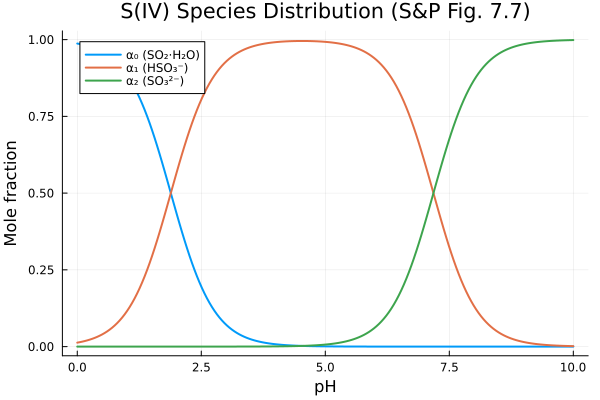
Effective Henry's Law Constant vs pH
The effective Henry's law constant H* for SO₂ increases with pH due to dissociation of dissolved SO₂ (S&P Eq. 7.41).
ATM = Aerosol.ATM_TO_PA
H_SO2_298 = 1.23 / ATM  # M/Pa

pH_range = range(0, 8, length = 200)
H_eff_vals = zeros(length(pH_range))
H_eff_atm = zeros(length(pH_range))

for (i, pH) in enumerate(pH_range)
    H_plus = 10.0^(-pH)
    H_eff_vals[i] = effective_henrys_constant(H_SO2_298, K_s1, K_s2, H_plus)
    H_eff_atm[i] = H_eff_vals[i] * ATM  # Convert back to M/atm for display
end

plot(pH_range, H_eff_atm, lw = 2, yscale = :log10, label = "H* SO₂")
hline!([1.23], ls = :dash, label = "H (intrinsic)", color = :gray)
xlabel!("pH")
ylabel!("H* (M/atm)")
title!("Effective Henry's Law Constant for SO₂ (S&P Eq. 7.41)")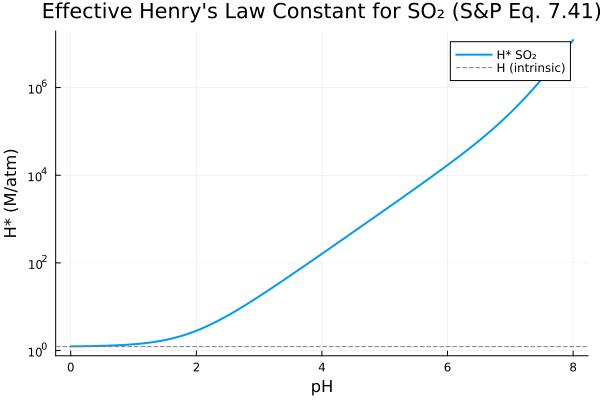
S(IV) Oxidation Rates vs pH
Comparison of the three main S(IV) oxidation pathways as a function of pH. This figure illustrates the pH-dependent dominance of different oxidants (cf. S&P Section 7.5).
ATM = Aerosol.ATM_TO_PA
H_SO2 = 1.23 / ATM
H_O3 = 1.1e-2 / ATM
H_H2O2 = 1.0e5 / ATM
K_s1 = Aerosol.K_S1_298
K_s2 = Aerosol.K_S2_298

# Typical atmospheric conditions
p_SO2 = 1e-9 * ATM  # 1 ppb
p_O3 = 50e-9 * ATM  # 50 ppb
p_H2O2 = 1e-9 * ATM # 1 ppb

pH_range = range(1, 7, length = 200)
R_o3 = zeros(length(pH_range))
R_h2o2 = zeros(length(pH_range))

k0 = Aerosol.K0_O3
k1 = Aerosol.K1_O3
k2 = Aerosol.K2_O3
k_h2o2 = 7.5e7
K_eq = 13.0

for (i, pH) in enumerate(pH_range)
    H_plus = 10.0^(-pH)
    SO2_aq = H_SO2 * p_SO2
    HSO3_m = K_s1 * SO2_aq / H_plus
    SO3_2m = K_s2 * HSO3_m / H_plus
    O3_aq = H_O3 * p_O3
    H2O2_aq = H_H2O2 * p_H2O2

    R_o3[i] = (k0 * SO2_aq + k1 * HSO3_m + k2 * SO3_2m) * O3_aq
    R_h2o2[i] = k_h2o2 * H_plus * H2O2_aq * HSO3_m / (1 + K_eq * H_plus)
end

plot(pH_range, R_o3, label = "O₃ pathway", lw = 2, yscale = :log10)
plot!(pH_range, R_h2o2, label = "H₂O₂ pathway", lw = 2)
xlabel!("pH")
ylabel!("Rate (mol/L/s)")
title!("S(IV) Oxidation Rates vs pH (S&P Section 7.5)")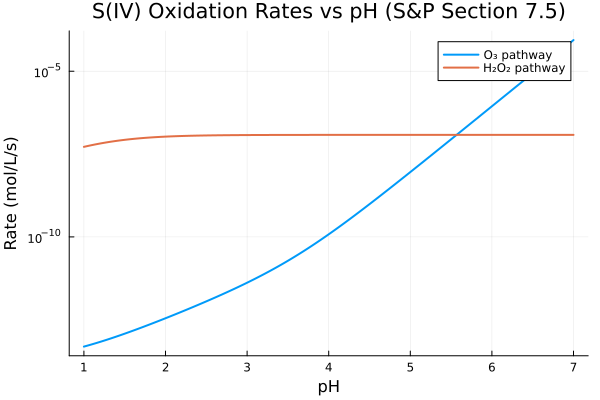
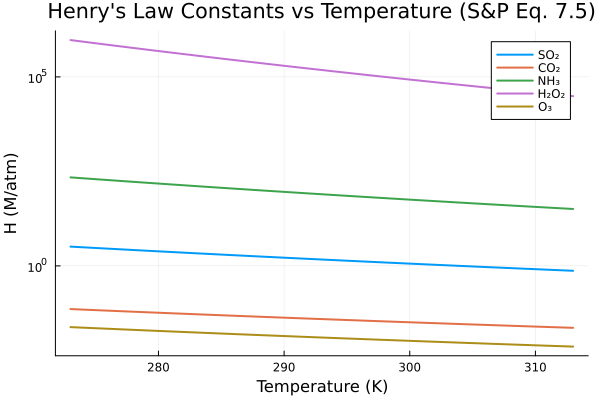
Temperature Dependence of Henry's Law Constants
Henry's law constants increase at lower temperatures for all species (exothermic dissolution), following the van't Hoff equation (S&P Eq. 7.5).
ATM = Aerosol.ATM_TO_PA
T_range = range(273, 313, length = 100)
species_list = [:SO2, :CO2, :NH3, :H2O2, :O3]
labels = ["SO₂", "CO₂", "NH₃", "H₂O₂", "O₃"]

plt = plot(yscale = :log10)
for (sp, lab) in zip(species_list, labels)
    H_298 = Aerosol.HENRY_CONSTANTS_298[sp]
    dH = Aerosol.DELTA_H_DISSOLUTION[sp]
    H_vals = [henrys_constant_at_T(H_298, dH, T) * ATM for T in T_range]
    plot!(plt, collect(T_range), H_vals, label = lab, lw = 2)
end
xlabel!(plt, "Temperature (K)")
ylabel!(plt, "H (M/atm)")
title!(plt, "Henry's Law Constants vs Temperature (S&P Eq. 7.5)")
plt